When you represent clients in GST disputes, one of the most frustrating scenarios is watching a legitimate business face sudden tax demands and blocked working capital simply because a vendor pocketed the tax and defaulted on their filings. For years, taxpayers have argued that honest buyers should not be penalized for a supplier’s fraud.
On 24 July 2026, the Supreme Court of India brought finality to this deeply debated issue. In the landmark case of Bhandari Scrap Traders v. Union of India, the Court affirmed the Gujarat High Court’s ruling and upheld the strict constitutional validity of Section 16(2)(c) of the CGST Act.
The judgment establishes an absolute, non-negotiable rule: your Input Tax Credit (ITC) is legally tethered to your supplier’s actual tax payment to the exchequer.
Here is a comprehensive look at the statutory framework, why old legal defenses will no longer work, and exactly how your business must file and manage ITC reversals moving forward.
The Statutory Framework: Why Invoices and Payments Are No Longer Enough
Under the GST regime, claiming Input Tax Credit is not a vested right; it is a statutory concession subject to strict conditions. Historically, many businesses operated under the assumption that if they satisfied the basic commercial requirements, their ITC was secure.
The Supreme Court has clarified that all clauses of Section 16(2) must be read conjointly. To claim ITC, a purchasing dealer must satisfy the entire checklist:
Section 16(2)(a): You must possess a valid tax invoice or debit note.
Section 16(2)(b): You must have actually received the goods or services.
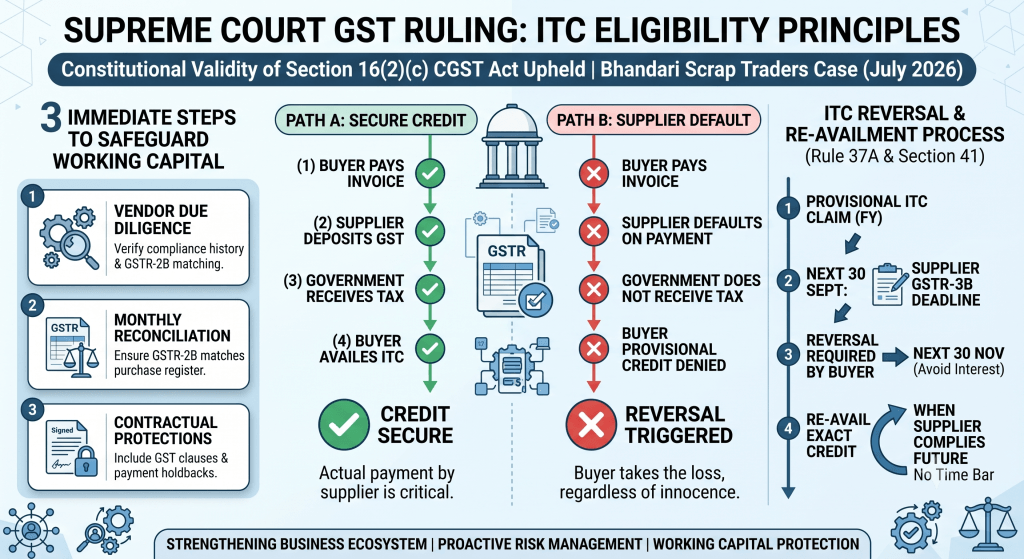
Section 16(2)(c): The tax charged in respect of such supply must have been actually paid to the Government by the supplier.
Under the law, the burden of proof lies entirely on the person claiming the ITC. Even if you have transferred the full invoice amount (including GST) to your supplier via official banking channels, your credit remains provisional until the exchequer actually receives the money.
The Demise of the “Bona Fide” Defense
During the litigation, taxpayers heavily relied on the legal maxim lex non cogit ad impossibilia—the law does not compel a man to do the impossible. The argument was straightforward: a buyer has no access to a supplier’s GSTR-3B filings and therefore cannot force them to deposit the tax.
However, the Supreme Court explicitly rejected drawing any parity between the old VAT regimes and the modern CGST Act. Under GST, the innocence or good faith of the buyer is irrelevant if the statutory condition of actual tax payment under Section 16(2)(c) is violated. The risk of supplier non-compliance now rests squarely on the shoulders of the purchaser.
Step-by-Step Compliance: How to Claim, Reverse, and Re-avail ITC
The Court noted that the GST framework provides a statutory mechanism under Section 41 and Rule 37A so that purchasers are not permanently deprived of their credit. Navigating these rules requires strict adherence to return filing timelines.
Here is exactly how your accounts team must handle ITC when a supplier defaults:
1. When to Claim ITC
You are entitled to claim the ITC in your monthly GSTR-3B during the tax period in which you receive the invoice and the goods/services. This is subject to the invoice reflecting in your GSTR-2B, meaning the supplier has reported it in their GSTR-1.
2. The Trigger: When to Monitor
Just because the invoice is in GSTR-2B does not mean the supplier paid the tax. The critical statutory deadline for the supplier to file their corresponding GSTR-3B and pay the government is 30th September following the end of the financial year in which you took the credit.
3. When and How to Reverse (The Penalty Zone)
If your supplier fails to file their GSTR-3B by the 30th September deadline, you are legally obligated to reverse the claimed ITC.
The Deadline: You must execute this reversal on or before 30th November of that same year.
How to File: You reverse this amount in Table 4(B)(2) of your GSTR-3B.
The Risk: If you fail to reverse it by 30th November, the ITC amount becomes a tax demand payable by you, along with a heavy 18% interest penalty under Section 50 of the CGST Act.
4. When and How to Re-avail (No Time Bar)
The reversal is not a permanent loss of money. Once the defaulting supplier eventually files their GSTR-3B and clears their tax dues, Section 41 allows you to reclaim your credit.
The Timeline: There is no time bar for this specific re-availment. The strict limitations of Section 16(4) do not apply to Rule 37A reclaims.
How to File: You can re-avail the exact same credit in Table 4(A)(5) and report it in Table 4(D)(1) of your GSTR-3B in the month the supplier finally complies.
ITC Reversal & Re-availment Timeline
30 September
Supplier DefaultYour supplier fails to file their GSTR-3B by the end of September following the financial year you took the credit.
30 November
Mandatory ReversalDeadline for the buyer to reverse the credit. If this deadline is missed, the reversed credit becomes payable along with interest.
No Time Bar
Credit Re-availmentThe credit is reversed, not destroyed. The day that supplier finally files the return, you can re-avail the exact same credit.
Practical Steps to Protect Your Business
The Bhandari Scrap Traders judgment effectively deputizes businesses to act as the first line of tax enforcement. Relying on blind trust is no longer commercially viable. To protect your balance sheet, you must adapt your operations immediately:
Implement Rigorous Vendor Due Diligence: You must verify the historical GST compliance of potential suppliers before awarding contracts. A vendor’s poor compliance record is now your direct financial liability.
Mandate GSTR-2B Reconciliations: Matching invoices manually is outdated. Your accounting teams must reconcile your GSTR-2B against your purchase register every month to identify which suppliers are actually depositing their tax.
Draft Defensive Commercial Agreements: Update your vendor contracts to include strict GST compliance warranties. We strongly advise structuring payment terms to hold back the GST component of a supplier’s invoice until you can verify that the corresponding return has been filed and the tax deposited.
The Supreme Court has drawn a clear line: the integrity of the supply chain matters just as much as the transaction itself. Navigating the reversal mechanisms and responding to departmental notices under Sections 73 and 74 requires precision and proactive management.
If your business is facing ITC reversals, or if you need assistance drafting vendor compliance clauses and managing GST appeals, reach out to us at Mookherjee Associates. We specialize in translating complex statutory shifts into actionable legal strategies that protect your bottom line.
3 Essential Steps to Protect Your ITC & Working Capital
1. Vendor Due Diligence
Verify the historical GST compliance of potential suppliers before signing commercial agreements. Actively choose partners with clean and consistent GST filing records.
2. Reconcile GSTR-2B
Perform strict monthly reconciliations of your GSTR-2B against your internal purchase register. Matching invoices alone is no longer enough to surface compliance gaps.
3. Defensive Contracts
Add strict GST compliance warranties to all vendor agreements. Consider holding back the tax payment component until the supplier officially files their return.