Understanding the GST on export of services is a critical requirement for any Indian freelancer or IT agency working with international clients. Landing international clients is a massive milestone for any Indian freelancer, consultant, or IT agency. But getting paid in USD, GBP, or Euros introduces a new layer of complexity: navigating the maze of India’s dual tax system—GST and Income Tax.
A note from the desk of Mookherjee Associates: In my practice, I frequently see service providers mistake foreign income for tax-exempt income. It is a dangerous misconception that has led many of my clients into unnecessary litigation and departmental notices. This guide is designed to help you avoid those exact pitfalls.
Many service providers mistakenly believe that because their clients are abroad, they are exempt from Indian tax laws. This is a dangerous misconception. Under Indian law, exporting services is considered a "Zero-Rated Supply." This means while you may not have to pay tax on your exports, you are absolutely required to prove your export status through strict compliance.
In this guide, we break down exactly how to manage your GST and Income Tax compliance for foreign income, keeping you penalty-free and financially optimized.
Part 1: GST Compliance for Export of Services
If you are providing services from India to a recipient located outside India, and the payment is received in convertible foreign exchange, your services qualify as an export. Here is what you need to do to stay compliant:
1. File Your LUT (Letter of Undertaking)
To invoice a foreign client without adding 18% IGST, you cannot simply send an invoice with "0% GST." You must first file a Letter of Undertaking (LUT) in Form RFD-11 on the GST portal.
Why it matters: The LUT is your formal declaration to the government that you will fulfill all export requirements. It must be renewed at the beginning of every financial year.
Pro-Tip from a Practitioner: While the process of filing an LUT is technically straightforward, the GST portal’s interface can be notoriously glitchy during peak filing periods at the end of the financial year. To avoid the frustration of last-minute server crashes and potential penalties, I always recommend to my clients that we file these as early as possible in April.
The Penalty: If you export without an active LUT, you are legally required to pay the 18% IGST out of pocket and then file a tedious refund claim.
2. Standardize Your Export Invoices
Your invoices to foreign clients must contain specific details to be recognized by the GST department. Ensure every invoice includes:
- The text: "Supply meant for export under bond or Letter of Undertaking without payment of integrated tax."
- Your GSTIN (Goods and Services Tax Identification Number).
- The client’s name and foreign address.
- The currency of the transaction (e.g., USD, EUR).
3. File GSTR-1 and GSTR-3B Accurately
Even with zero tax liability, you must file your returns.
- In your GSTR-1, export invoices must be declared under Table 6A (Exports).
- In your GSTR-3B (your summary return), the total export value must be declared under the "Zero-Rated Supplies" column.
4. Secure Your e-FIRA
When your foreign payment hits your Indian bank account, the bank issues a Foreign Inward Remittance Certificate (FIRC) or an e-FIRA (Electronic Foreign Inward Remittance Advice). Keep these safe. This document is the ultimate legal proof that your payment arrived in convertible foreign exchange, officially cementing your transaction as an export.
Part 2: Income Tax Strategies for Foreign Income
While GST deals with the service itself, the Income Tax Act dictates how you are taxed on the profit you make from those services.
1. Maximize Savings with Section 44ADA (Presumptive Taxation)
If you are a notified professional (such as a software developer, marketing consultant, architect, or designer) and your total gross receipts are under ₹50 Lakhs (or up to ₹75 Lakhs provided 95% of your receipts are received via digital banking channels), you can opt for Section 44ADA.
This scheme allows you to declare 50% of your gross foreign income as direct profit, eliminating the need to maintain complex expense books. You simply pay tax on that 50% according to your income tax slab.
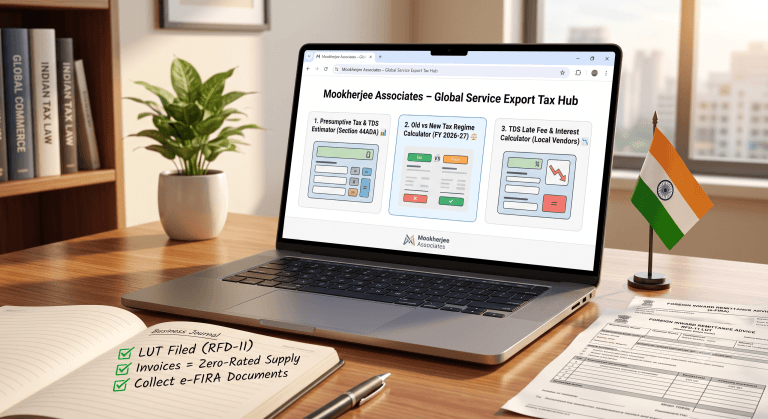
Calculate Your Liability Instantly: Want to know exactly how much you can save? Use our free Presumptive Tax & TDS Estimator to run your numbers and optimize your tax outflows.
2. Choose the Right Tax Regime
The Indian government has heavily incentivized the New Tax Regime, but for freelancers and business owners with specific deductions, the Old Regime might still hold value. Choosing the wrong regime can result in paying thousands of rupees more in tax than necessary.
Make a Data-Driven Decision: Don’t guess your tax slab. Input your estimated export revenue into our Old vs. New Tax Regime Calculator to find the most profitable route for the 2026-27 financial year.
3. Claiming Relief Under DTAA (Double Taxation Avoidance Agreement)
Occasionally, a foreign client or platform might deduct tax at the source in their home country before sending the money to India. Because India has a DTAA with most major economies (like the US and UK), you do not have to pay tax twice. You can claim a Foreign Tax Credit (FTC) by filing Form 67 before filing your Indian Income Tax Return (ITR).
Part 3: Scaling Up? Don't Forget Your Own TDS Compliance
As your export business grows, you will likely start hiring local Indian subcontractors, renting office space, or paying for professional services.
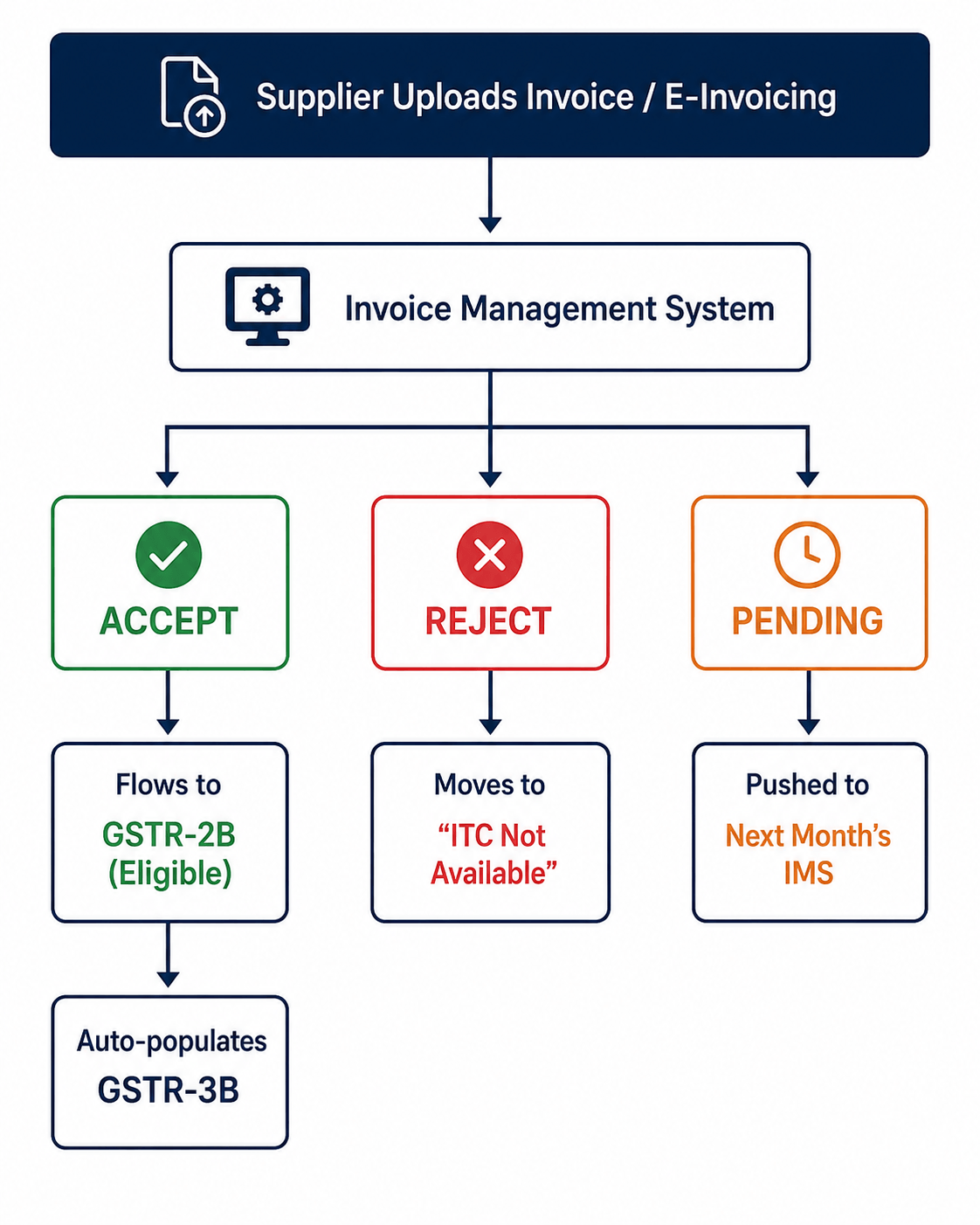
Master the Invoice Management System (IMS)
As your business scales, remember that as of 2026, the GST portal enforces hard blocks on Input Tax Credit (ITC) if you do not actively manage your Invoice Management System (IMS) dashboard. You must actively Accept, Reject, or mark invoices as Pending to ensure your ITC flows correctly to your GSTR-2B.
TDS Deductions
Once your business crosses the tax audit threshold, you are legally required to deduct TDS (Tax Deducted at Source) when paying your local vendors and deposit it to the government on time.
Failing to deduct or deposit TDS attracts severe penalties and interest of up to 1.5% per month.
Stay Ahead of Deadlines: If you are managing a growing team and want to ensure your domestic compliance is as flawless as your international exports, use our Free TDS Late Fee & Interest Calculator (Tax Year 2026-27) to audit your liabilities and prevent Departmental notices.
The Bottom Line
Exporting services from India is highly lucrative, and the government encourages it by offering zero-rated GST benefits. However, the golden rule of Indian taxation applies: Exemption from tax is not an exemption from paperwork.
Managing your LUT, FIRA documentation, and ITR filings proactively ensures that you can focus on scaling your global client base rather than fighting legal battles.