
In a recent Kolkata case regarding a succession or will, a woman's decisive action reshaped her family's property inheritance. By demonstrating her rightful ownership and coparcenary rights under the Hindu Succession Act, she secured a share that would otherwise have been lost to disputes. This real-world example highlights how inheritance laws intersect in practice, and why understanding women's property rights in India is more crucial now than ever.
Navigating property inheritance often means dealing with a complex mix of statutory rules and longstanding family traditions. Clear legal rights streamline partitions and prevent delays, benefiting families and enterprises alike. Understanding how laws around succession and wills work together can make a profound difference, not just in protecting assets, but in ensuring families stay harmonious.
1. The Historical Landscape of Women's Property Rights in India
Before the codification of laws in 1956, Hindu women navigated a property landscape shaped heavily by local customs. Traditional inheritance norms typically favored male heirs, leaving women's control over both ancestral and self-acquired property severely limited.
The Impact of Mitakshara and Dayabhaga
- Mitakshara: Linked property strictly to the male line, with coparcenary (joint heirship) rights centered on fathers and elder male relatives.
- Dayabhaga: Emphasized lineage through the father but applied different inheritance rules.
In a joint family, a daughter's stake was often limited to a token share unless a specific decree granted her more. Growing calls for gender equality spurred the need for a unified framework to standardize inheritance rules and provide women with enforceable rights.
2. The Hindu Succession Act 1956: Core Principles
The Hindu Succession Act of 1956 provided a unified framework for inheritance among Hindus (including Buddhists, Jains, and Sikhs). It standardized property transfer upon death and clarified who inherits when a person dies without a will.
The Act granted women equal rights to inherit property from a father, husband, or other relatives. However, the mechanics of coparcenary, which dictates how eligible relatives share ancestral property, still heavily favored male members until modern reforms took effect.
"Progressive reform in Hindu succession law has transformed women from mere heirs of male kin to equal coparceners, signaling a decisive shift toward gender-equal property rights in India." – Legal Scholar
3. The 2005 Amendment: Equality from Birth
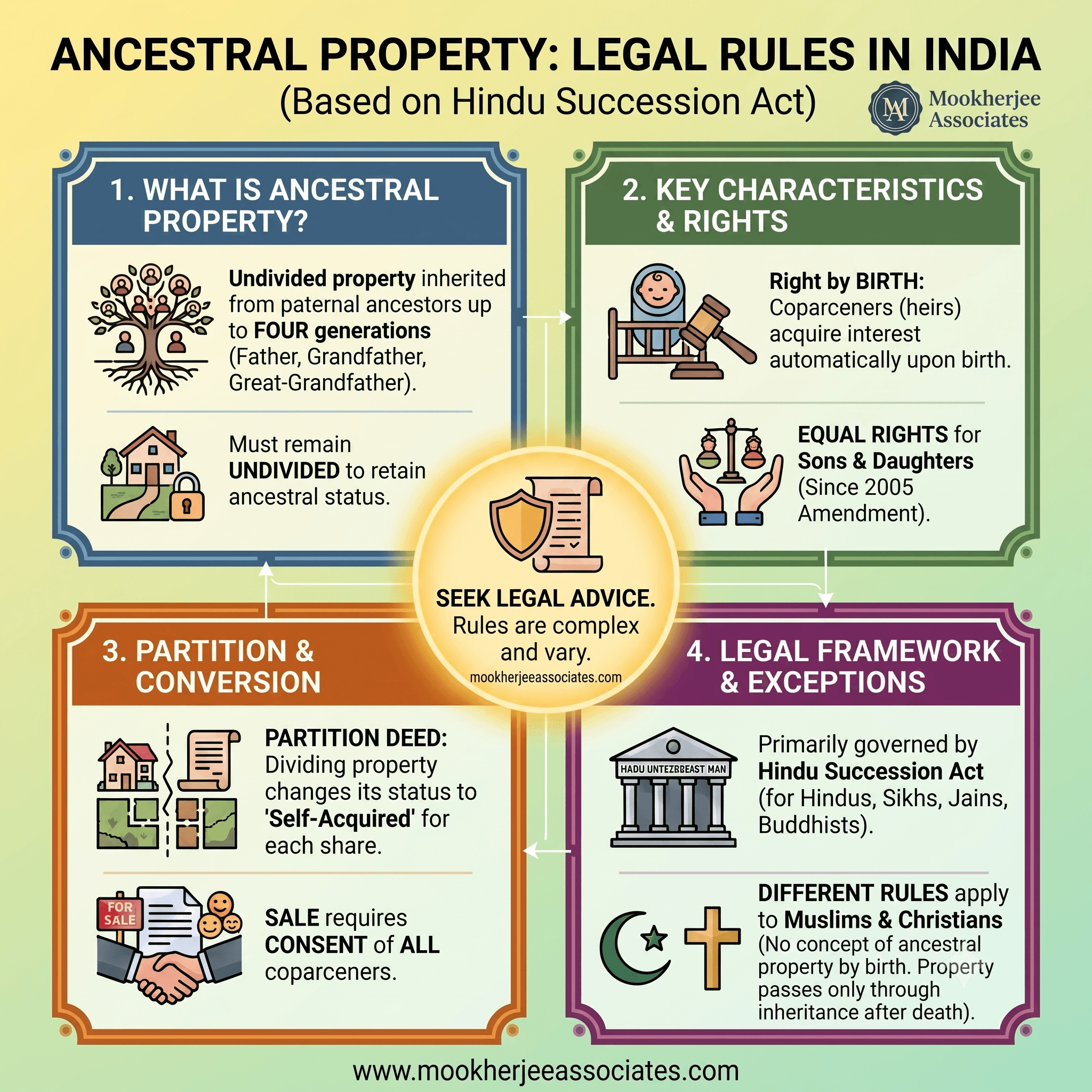
The legal landscape shifted dramatically with the Hindu Succession (Amendment) Act 2005. This landmark reform expanded coparcenary rights to daughters of all ages in joint Hindu families, granting them equal rights to ancestral property from birth.
- Right by Birth: This amendment permanently secured the ancestral property rights of daughters, giving them the exact same legal footing as sons, subject to pro-rata shares and existing valid partitions.
- Agricultural Land: The amendment recalibrated the devolution of agricultural land. Daughters now hold coparcenary rights here as well, strengthening rural women's stake in family assets.
- Operational Considerations: Families must map land records to show daughters as coparceners in revenue entries to prevent mismatches between mutation entries and succession deeds.
Landmark Supreme Court Judgments Strengthening Women's Rights
To fully understand a daughter's right in father's property, courts rely on these critical precedents:
- Vineeta Sharma v. Rakesh Sharma (2020): A monumental three-judge bench ruling which clarified that daughters have coparcenary rights by birth, regardless of whether the father was alive when the Hindu Succession Act 2005 amendment came into force.
- Arunachala Gounder v. Ponnusamy (2022): The Supreme Court ruled that a daughter can inherit the self-acquired property or properties obtained through partition by her Hindu father dying intestate (without a will), getting preference over other collateral members.
4. Succession Scenarios: Intestate Succession vs Will
Families often navigate inheritance through a mix of statutory rules and personal wishes. Understanding the difference between inheriting through a will and inheriting through statutory succession is vital to safeguarding assets.
| Feature | Will-Based Transfer (Testamentary) | Intestate Succession (No Will) |
|---|---|---|
| Applicability | Governs assets detailed in a valid, registered will. | Applies when a person dies without a valid will. |
| Self-Acquired Property | The testator can freely bequeath to anyone of their choosing. | Distributes equally among Class-I heirs (widow, children, etc.). |
| Ancestral Property | Cannot override statutory coparcenary rights (e.g., a daughter's birthright). | Devolution follows statutory shares under the Hindu Succession Act. |
Avoiding Common Missteps: Do not assume a will automatically overrides statutory shares. A will lets you decide who inherits self-acquired assets, but it must respect coparcenary rights for ancestral property. Always update documents after major life events.
5. Navigating Different Property Types
How rights are exercised depends entirely on the nature of the property:
- Self-Acquired Property: You hold equal rights to inherit and transfer self-acquired property. A will offers flexibility in allocating these assets directly to chosen beneficiaries.
- Joint Family and Ancestral Property: Daughters hold coparcenary status, entitling them to equal shares from birth. Partition petitions and court declarations must consistently reflect these principles to reduce the risks of title reversals later on.
6. Planning, Compliance, and Strategic Advice
The core challenge for many families is balancing traditional expectations with modern statutory protections. Whether you are dealing with statutory succession or will drafting, at Mookherjee Associates, we support clients through intricate planning with a clear focus on regulatory alignment.
- Document Everything: Maintain clear title deeds, birth certificates, and settlement records to prevent disputes.
- Safeguard with a Solid Will: Draft a will that aligns with statutory rights (including Section 30 testamentary rights). Specify property distribution by exact shares.
- Update Titles and Records: Ensure deeds reflect current rights under the Hindu Succession Act to avoid conflicting encumbrances.
Conclusion
Women's property rights in India now actively shape practical decisions across family homes, farms, and business assets. With daughters holding coparcenary status from birth, relying on informal arrangements is no longer a viable strategy. By blending property law with practical tax planning and asset protection, you can move from concepts to enforceable arrangements, securing your legacy for the future.
Frequently Asked Questions (FAQ)
What is a daughter's right in father's property?
Under the Hindu Succession Act 2005, a daughter has an equal right to her father's ancestral property by birth, just like a son. For the father's self-acquired property, it depends on whether he leaves a valid will or if the property is distributed through intestate succession (where she ranks as a Class I heir).
Can a widow claim a share in ancestral property?
Yes, widows are legal Class I heirs with defined shares under intestate succession rules and can pursue formal mutation of title to secure their interest.
Are there differences between self-acquired and ancestral property rights?
Self-acquired property can be bequeathed freely to anyone via a will. Ancestral shares, however, follow strict coparcenary rules (birthright) and cannot be entirely given away to an outsider via a will, as other coparceners have guaranteed shares.
Need Expert Legal Assistance for Your Property?
Navigating inheritance laws, partition deeds, and drafting legally sound wills can be overwhelming. Whether you need to secure your coparcenary rights or execute a flawless succession plan, our legal experts are here to protect your family's legacy and prevent protracted litigation.
Consult Our Property Lawyers in Kolkata