If you run a small business in India—whether it is a building materials shop, a retail store, or a local trading counter—you already know how hard it is to secure bank funding.
You might have a healthy daily cash flow and plenty of inventory, but the moment you ask a bank for a ₹10 Lakh working capital loan, the credit manager asks for two things: a GST registration and three years of Income Tax Returns (ITR). If you are an unorganized business or a first-time filer, you probably do not have either.
Does this mean your loan will be rejected? Not necessarily.
With the right financial presentation, you can legally reconstruct your financial history, satisfy the bank’s credit manager, and stay completely safe from Income Tax notices. Here is exactly how professional tax consultants build a “Project Report” to get your loan approved.
1. The Power of “Projected Financials”
When a business has no formal books of account, banks rely on a drafted set of financials—a Trading & Profit & Loss (P&L) Account and a Balance Sheet. The goal of these documents is to prove to the bank that your business is stable enough to pay back a monthly EMI.
To do this, we look at your bank statement deposits to estimate your total yearly sales (Turnover) and then work backward to calculate two critical margins:
Gross Profit (The Trading Margin): This is the direct profit you make on your goods before paying your shop’s rent, electricity, or staff. For example, if you sell building materials, banks expect to see a Gross Profit of about 12% to 18%.
Net Profit (The Bottom Line): This is the final money you take home after all business expenses are paid. If you need a ₹10 Lakh loan, your yearly Net Profit needs to be roughly double your expected annual EMI. This proves to the bank that you can pay the loan and still survive.
2. Margin of Safety: Your Financial Shock Absorber
Bank credit managers are naturally cautious. Before they approve your loan, they want to know what happens if the market crashes and your sales drop.
This is where the Margin of Safety comes in.
Imagine your business needs to make exactly ₹15 Lakhs a year in sales just to cover your fixed costs (like rent and salaries) and break even. If your actual sales are ₹48 Lakhs, your Margin of Safety is a massive ₹33 Lakhs. By clearly highlighting this safety cushion in your loan application, you tell the bank: “Even if my sales drop by 60%, I will still not go into a loss, and your EMI is completely safe.”
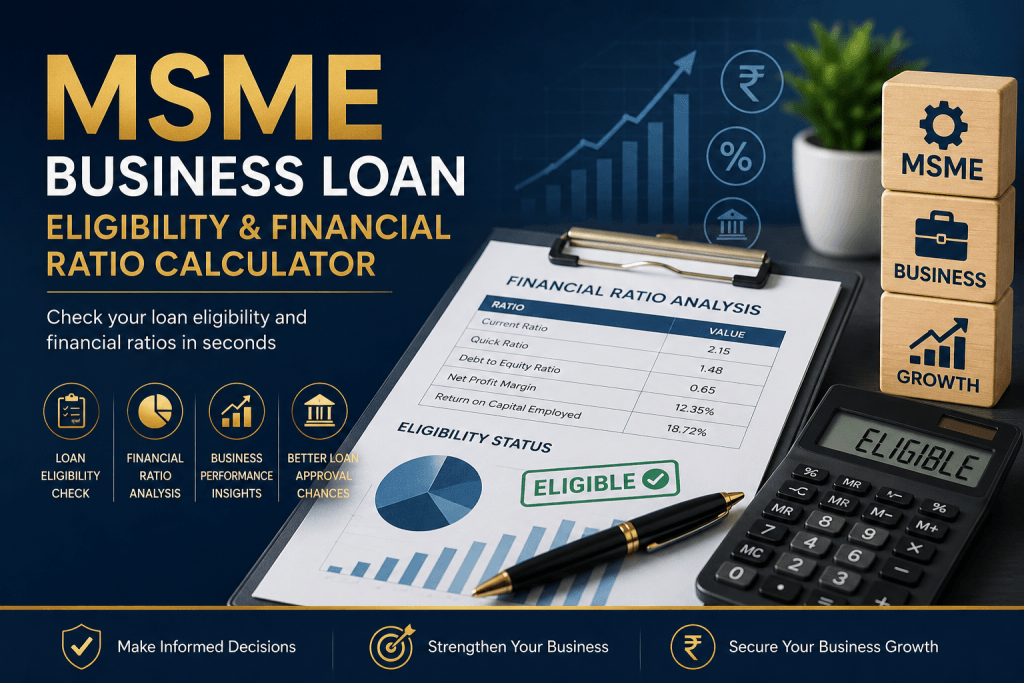
(Want to check if your business has a strong enough safety cushion? Try our MSME Business Loan Eligibility And Financial Ratio Calculator tool to calculate your exact Margin of Safety instantly!)
3. “Capital Formation” (The Secret to First-Time Balance Sheets)
This is the most critical step, and where many DIY taxpayers get into serious legal trouble.
When you file an ITR for the very first time to get a loan, you have to submit a Balance Sheet. Let’s say your Balance Sheet shows that you own ₹10 Lakhs worth of shop inventory and a small commercial property. The Income Tax Department’s computers will instantly ask a logical question: If you have never filed taxes before, where did the money come from to buy ₹10 Lakhs worth of assets?
If you cannot explain it, the tax department can treat your assets as “unexplained income” under Section 68 or 69 of the Income Tax Act, hitting you with a brutal 78% tax and heavy penalties.
To prevent this, professionals use a legal process called Capital Formation. We legally trace and document your accumulated past wealth—whether it came from years of tax-free agricultural income, past savings that fell below the taxable limit, or legal cash gifts from family members. This provides a clean, legally bulletproof explanation for your Day 1 wealth, keeping your file safe from tax scrutiny.
The Loan Approval Workflow for Unorganized Businesses
We review your actual banking credits to estimate a realistic total sales figure that keeps you safely below mandatory tax audit limits while justifying your loan.
We structure your direct and indirect expenses to establish an industry-standard Gross Profit and ensure your Net Profit is at least double your target EMI.
We map your current physical assets (shop, stock, cash) and legally document your accumulated past wealth to create a bulletproof Opening Capital defense.
We file your simplified tax return under Section 44AD (Presumptive Taxation) and hand you a professional Project Report ready for the credit manager's desk.
4. The Section 44AD Advantage (Keep It Simple)
If your business turnover is under ₹2 Crores, you have a massive legal advantage: Section 44AD (Presumptive Taxation).
Instead of maintaining complicated daily accounting books and calculating complex asset depreciation every year, the government allows you to simply declare a flat percentage of your total sales as profit (8% for cash sales, 6% for digital).
By utilizing Section 44AD, you get the best of both worlds:
For the Bank: You present a clean, attractive estimated balance sheet showing healthy margins.
For the Government: You file a highly simplified ITR-4, drastically reducing your compliance burden and avoiding a mandatory tax audit.
Planning Your Next Steps
Securing a business loan without past records is entirely possible, but it requires strategic financial engineering. Your turnover, your net profit, and your opening capital must tell a single, mathematically perfect story that satisfies both the bank’s credit department and the Income Tax portal.
Ready to see if your business qualifies? Use our interactive Business Loan Feasibility Assessor to calculate your exact EMI capacity and Margin of Safety, or contact the team at Mookherjee Associates for expert help in drafting your customized project report.