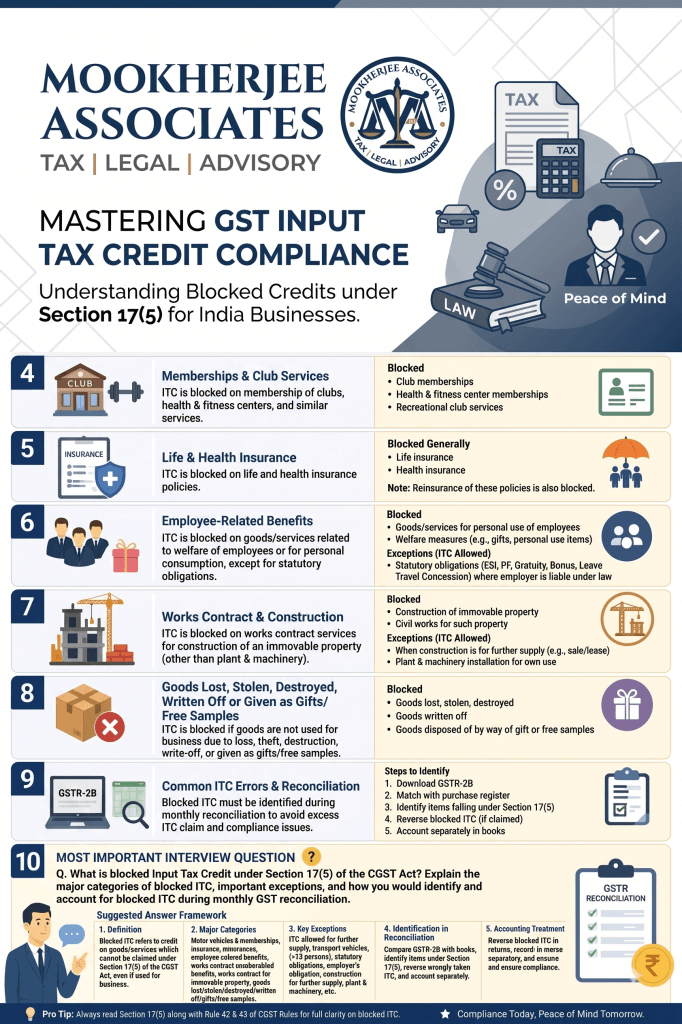
Let’s start with a common misconception. As business owners, we naturally assume that if we pay GST on a legitimate business expense, we are automatically entitled to claim that back as Input Tax Credit (ITC). Unfortunately, the GST law doesn’t quite work that way.
Under the GST framework, ITC is considered a benefit provided by the government, not an absolute legal right. To prevent the misuse of tax credits for personal consumption, the government introduced Section 17(5) of the CGST Act, commonly known as the “Blocked Credit” list.
Even if you buy something strictly for your business, if it falls under this section, your ITC is blocked. Claiming it by mistake is one of the easiest ways to trigger a scrutiny notice from the tax department.
Let’s break down the major categories of blocked ITC in plain English, look at the real-world scenarios where they apply, and highlight the crucial exceptions that could save your business money.
1. The “Company Car” Dilemma: Motor Vehicles & Conveyances
One of the most frequent questions we get asked is: “I bought a car in the company’s name for my sales team. Can I claim the ITC?”
The short answer is usually no. The tax department generally views motor vehicles with a seating capacity of 13 persons or less (which covers almost all standard cars and SUVs) as items prone to personal use. Therefore, the ITC on the purchase, servicing, and insurance of these vehicles is completely blocked.
When can you claim it? (The Exceptions) The law provides relief if your core business actually relies on these vehicles. You can claim the ITC if:
You run a car dealership and buy vehicles to sell them further.
You run a taxi or renting service.
You operate a driving school.
You purchase a larger vehicle (like a minibus or bus) with a seating capacity of more than 13 people to transport your employees.
The vehicle is strictly for the transportation of goods (like a delivery truck or a loading tempo).
2. Office Lunches & Events: Food, Beverages & Outdoor Catering
We all know that taking a prospective client out to dinner or hosting an outdoor catering event for the annual founders’ day is a genuine business expense. However, the GST you pay on that hotel or catering bill goes straight to your cost column. ITC on food, beverages, and outdoor catering is strictly blocked.
When can you claim it? (The Exceptions) The only time you can legally claim ITC on food and catering is if providing it is a statutory obligation. For example, if you run a manufacturing plant with more than 250 workers, the Factories Act mandates that you must provide a canteen. Because the law forces you to provide it, the GST law allows you to claim the ITC on those catering services.
3. The Executive Perks: Memberships, Health & Fitness Clubs
If a company pays for a CEO’s golf club membership or provides gym memberships for its management team as an executive perk, the ITC is blocked. The government categorizes these strictly as personal consumption, regardless of whether the company pays the invoice. There are no standard exceptions here unless an employment law specifically mandates it.
4. Employee Protection: Life & Health Insurance
Providing group health insurance or life insurance for your employees is an excellent welfare measure. However, the premiums are heavy, and they include an 18% GST component. Generally, the ITC on these insurance policies is blocked.
When can you claim it? (The Exceptions) Just like the canteen rule, you can claim this ITC only if a specific law makes it mandatory for you as an employer to provide that insurance. If you are doing it voluntarily as a company perk, the tax credit is dead.
5. Festive Gifts & Welfare: Employee-Related Benefits
During Diwali or the New Year, businesses regularly buy gifts for their employees and clients. Alternatively, you might buy goods for the personal use of your staff. Section 17(5) clearly states that ITC is blocked on goods or services used for personal consumption or given as gifts.
If you buy 100 boxes of sweets or electronics to distribute as free corporate gifts, you cannot claim the ITC. If you do, and the tax officer spots the “gift” ledger during an audit, you will be forced to reverse it along with heavy interest.
6. Expanding Your Operations: Works Contract & Construction
Imagine your business is growing and you decide to construct a new corporate office. You hire a contractor who raises a massive invoice containing a significant amount of GST.
Can you claim it? No. ITC is blocked on works contract services and goods used for the construction of an immovable property (like a building) on your own account. This applies even if you are capitalizing the building in your books to run your business from it.
When can you claim it? (The Exceptions)
If you are a builder or developer constructing the property to sell or lease it further, you can claim the credit.
If the construction involves the installation of plant and machinery (like building a specific foundation to hold a heavy manufacturing machine), the ITC for that specific portion is allowed.
7. The Double Whammy: Goods Lost, Stolen, or Destroyed
This is a bitter pill to swallow. If a fire breaks out in your warehouse, or goods are stolen or destroyed in transit, you suffer a massive financial loss. But the GST law adds insult to injury.
Because those goods will never be sold (and thus will never generate output tax for the government), Section 17(5) mandates that any ITC you previously claimed when you purchased those goods must be reversed. You cannot keep the ITC for goods that are written off or destroyed.
How to Protect Your Business: The Reconciliation Process
The tax department’s systems are entirely automated today. If your ITC claims don’t match the rules, the system will flag it. Failing to identify these blocked credits internally leads to excess ITC claims, followed by notices and penalties.
To ensure total compliance, your monthly accounting process should look like this:
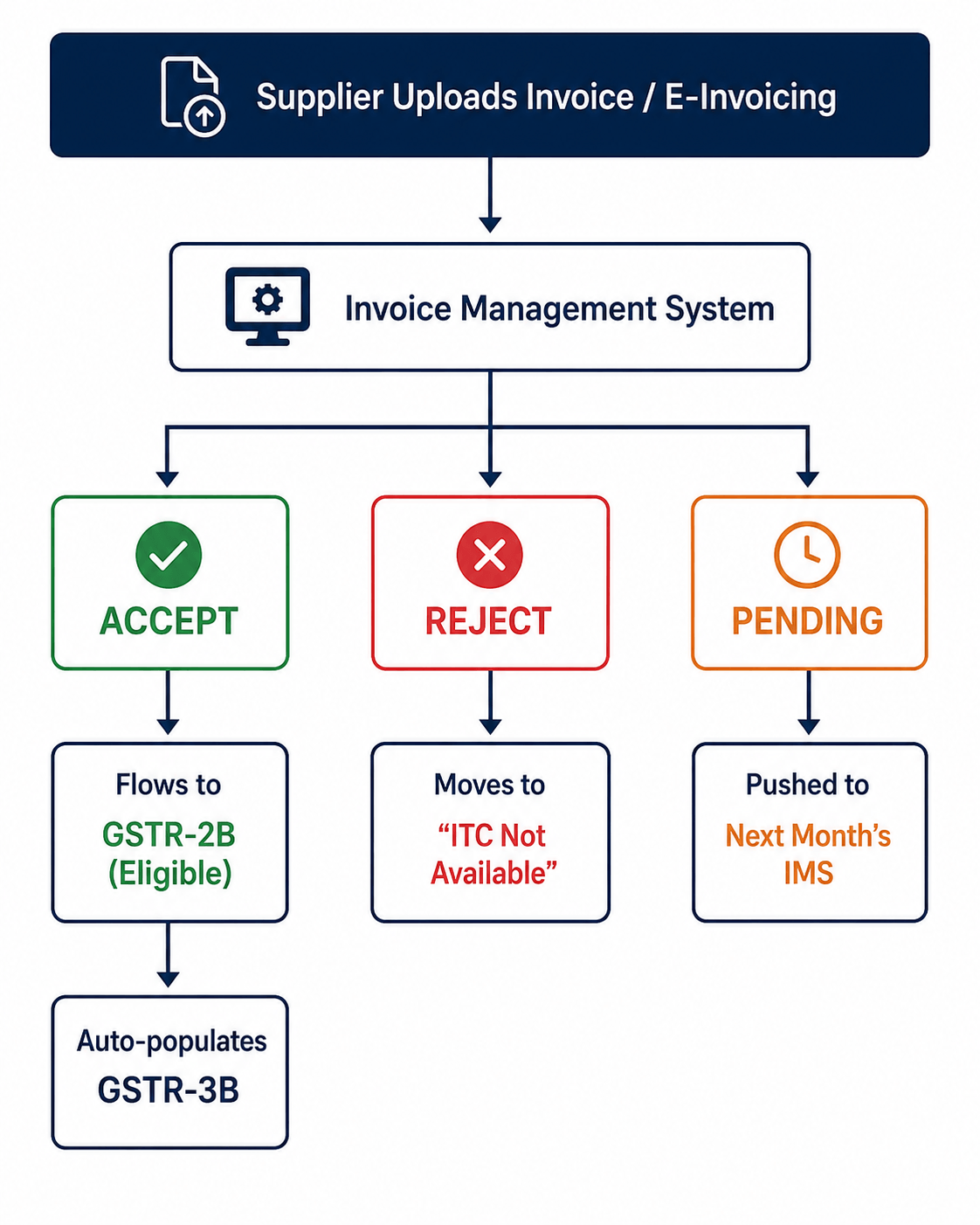
Download your GSTR-2B: This is your auto-drafted statement from the GST portal showing what your vendors have uploaded.
Match strictly with your books: Do not blindly accept the portal’s numbers. Cross-reference them with your actual purchase register.
Identify the Danger Zones: Actively scan the list for Section 17(5) items—look for restaurant bills, car servicing invoices, insurance premiums, and construction materials.
Reverse the Blocked ITC in GSTR-3B: This is the most crucial step. Even if the portal auto-populates the ITC, you must manually report the reversal. Ensure this is accurately disclosed under Table 4(B)(1) of GSTR-3B (ITC Reversed: As per rules 42 & 43 of CGST Rules and section 17(5)).
Maintain Clean Ledgers: Make sure your accounting software records blocked ITC as an expense rather than an asset, keeping your audit trails crystal clear.
Tax compliance requires vigilance. By understanding what is rightfully yours and what is blocked by law, you protect your working capital and secure peace of mind for your business.
MOOKHERJEE ASSOCIATES
Tax & Legal Consultants
GST INPUT TAX CREDIT – BLOCKED CREDITS (SEC 17(5))
- Used for further supply (e.g., dealerships)
- Passenger transport (>13 persons)
- Goods transport vehicles
- Obligatory for employer to provide under any current statutory law.
- No standard exceptions unless mandated by law.
- Obligatory for employer to provide under statutory law.
- Construction is for further supply (sale/lease).
- Plant & machinery installation for own use.
- None. Must be reversed if previously claimed.
⚠️ 5-Step Reconciliation & GSTR-3B Reporting
Tax laws are complex, and the financial cost of an ITC mismatch can be severe. If your business has already received a GST scrutiny notice, a show-cause notice, or an assessment order regarding blocked ITC under Section 17(5), you do not have to navigate the tax department alone.
At Mookherjee Associates, we specialize in defending businesses in complex tax disputes, from drafting robust legal replies to representing clients before the Appellate Tribunal. We ensure your rights as a taxpayer are fully protected.
Contact us today for a comprehensive case evaluation and expert legal representation.